

Schools and other educational facilities account for a significant share of commercial and industrial (C&I) waste. The amount is nearly half of the country’s total, with 32.9 million tonnes generated in 2022 to 2023. Picture classrooms and campuses, places of learning, but they are actually hotspots for potential environmental hazards, requiring immediate action.
Annual Waste Generation in the Education Sector
C&I waste reached 32 million tonnes, according to the latest National Waste and Resource Recovery Reporting. This figure accounts for 44% of the country’s total waste generation.
The C&I waste category includes waste from businesses and institutions, including offices, restaurants, retail and wholesale operations, manufacturing facilities, and schools. There are currently no specific figures available for waste generated solely by the education sector.
Average Waste Generated per Student
The average Australian student generates significant waste during school hours. Schools participating in various waste initiatives reported an average of 1.97 tonnes per student annually across both primary and secondary levels.
Here are more accurate figures from Recycle Now:
- A secondary student generates around 22 kg of trash per year
- A primary student produces around 45 kg of rubbish per year
Organic Waste: A Major Part of School Trash
A large portion of school waste is organic (food scraps from lunchrooms, garden trimmings, fruit and vegetable peelings, and leftover snacks).
Reports state that with efficient management, up to 89% of this waste can be diverted from landfills:
- 40% Organic waste – suitable for composting, worm farms, or separated as organics
- 37% Paper and cardboard – recyclable materials
- 12% Mixed recyclable – commingled trash
- 11% Other forms of rubbish
In addition to organic and paper waste, schools face growing electronic waste (e-waste) from outdated technology. E-waste is more difficult to reclaim and recycle, complicating the educational sector’s waste management efforts.
The Data on School Waste Generation
National Waste Generation: The Big Picture
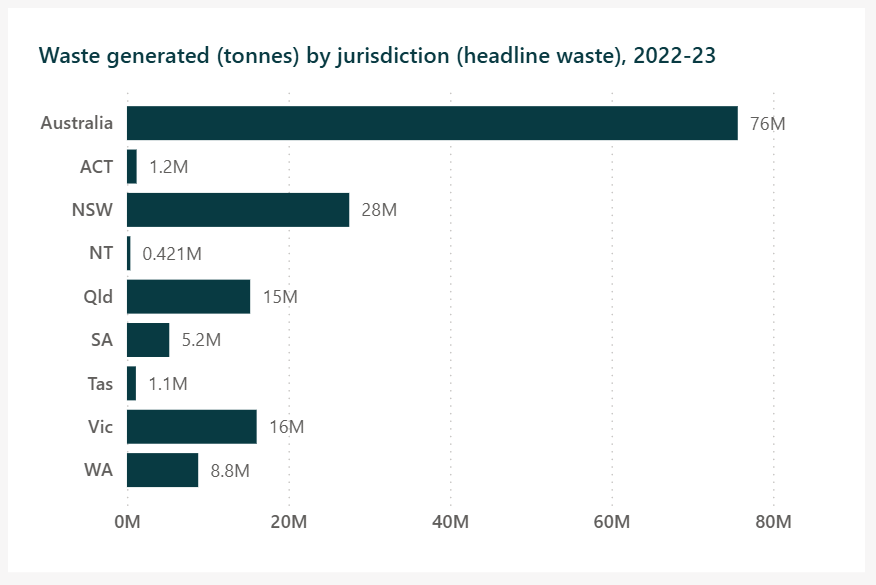
National Waste Report. Source: DCCEEW
The latest national waste report indicates a staggering amount of headline waste requiring immediate attention. Around 75.6 metric tonnes of headline waste, composed of MSW, C&I, and C&D rubbish, were generated.
- Municipal Solid Waste (MSW) – 13.5 metric tonnes, approximately 512 kg per person, and 18% of the total waste generated.
- Commercial and Industrial Waste (C&I) – 32.9 metric tonnes, 44% of the total.
- Construction and Demolition Waste (C&D) – 29.2 metric tonnes, 39% of the total.
Let’s take a closer look at what makes up this mountain of waste. By category, Australia’s waste stream included:
- 26.8 metric tonnes of building and demolition materials – concrete, bricks, timber, and rubble coming from construction sites and demolition projects.
- 14.6 metric tonnes of organics – food scraps, garden clippings, and biodegradable waste.
- 10.3 metric tonnes of ash – these are mainly from energy production and industrial processes.
- 6.5 metric tonnes of hazardous wastes – chemicals, medical waste, oil, and paints.
- 6.0 metric tonnes of metals – aluminium cans, scrap steel, and other discarded metal.
- 4.9 metric tonnes of paper and cardboard – these are from packaging materials, newspapers, and office paper.
- 3.0 metric tonnes of plastics – mostly single-use plastic bottles, packaging, and plastic film.
Overall, Australia has generated around 65.4 metric tonnes of core waste, about 2.49 tonnes per capita. This number is up from 57.8 metric tonnes in 2016 to 2017.
Waste Per Capita: From Student to School
The table below puts Australia’s mounting school waste into perspective.
| Estimated Amount of Rubbish per Student | Estimated Amount of Rubbish per Classroom | Estimated Amount of Rubbish per School | |
| Secondary School | 22 kg per year | 506 kg per year (23 students per classroom) | 15,180 kg per year (30 classrooms in a typical secondary school) |
| Primary School | 45 kg per year | 1,215 kg per year (27 students per classroom) | 18,225 kg per year (15 classrooms in a typical primary school) |
The figures in this table are based on recent Recycle Now data. Classroom sizes used for these calculations are estimates. Actual class and school sizes vary across regions and districts in Australia.
Future Forecasts & Trends
As the country’s population grows and schools increasingly rely on technology, the volume of waste generated by this segment is expected to increase significantly in the coming years.
At the same time, a strong trend toward greater environmental accountability, such as schools adopting more sustainable waste-management practices, will help reduce the waste footprint.
Projected Growth in Waste Generation
Population growth, together with increasing use of digital devices, laboratory materials, and packaged goods, will likely drive higher levels of general and e-waste in Australian schools.
The country’s population is expected to reach around 41.2 million by 2064 to 2065, according to the Australian Institute of Health and Welfare. If current patterns continue, per-student and per-school waste will rise steadily over the next decade.
Rising Challenges in E-Waste Management
The increasing reliance on technology in classrooms will make e-waste a significant component of school waste streams. E-waste comprises outdated devices, peripherals, and batteries, all of which require careful recycling and disposal to prevent environmental harm.
Shift Toward Sustainability
Australian schools are responding to environmental pressures by adopting recycling programs through local or private initiatives. Additionally, state-specific initiatives, such as the WasteSorted Schools program in Western Australia, are making significant progress. This effort recently funded 43 schools in a single grand round.
The Composition of a Typical School’s Waste Stream
Chart data from: WasteSorted Schools
Organic & Food Waste: The Largest Contributor (40-50%)
Organic and food waste are the largest component of school waste, accounting for 40-50%. This waste stream is usually composed of:
- Uneaten lunches
- Fruit peels
- Canteen leftovers
When these materials are sent to landfills, they decompose anaerobically, producing methane, a greenhouse gas 25 times more potent than carbon dioxide. Schools can mitigate this impact by implementing composting programs, utilising worm farms, or segregating organic waste.
Students must be encouraged to minimise food waste or donate uneaten food to promote sustainability. Properly managed organic waste can be converted into compost for use in school gardens.
Paper & Cardboard: The Recyclable Giant (20-30%)
Paper and cardboard account for 20 to 30% of school waste streams. These items are recyclable but may be contaminated by liquids or food scraps, which significantly reduce their recyclability.
- Classroom paper
- Worksheets
- Educational supply packaging
- Food packaging
- Outdated textbooks and educational supplies
By implementing paper and cardboard collection programs, schools can greatly reduce landfill contributions. Recycling conserves trees, reduces energy consumption and greenhouse gas emissions.
Additionally, separating paper and cardboard from other waste streams can improve recycling efficiency, ensuring they are repurposed effectively.
Co-mingled Recycling (Plastics, Glass, Aluminium)
Comingled recycling is composed of the following:
- Drink bottles
- Food containers
- Mixed recyclables
These materials are often collected in shared bins, so contamination is a common concern. Food residue, non-recyclable plastics, and broken items can significantly impact the recyclability of materials.
Schools should implement proper education and bin labelling to reduce contamination. Plastics, glass, and aluminium are highly recyclable because they can be processed into new products. By rinsing containers, removing caps, and avoiding mixing waste, material quality is maintained and the amount of waste sent to landfills is reduced.
E-Waste: The Growing Technological Challenge
The frequent turnover of electronic devices, such as computers, tablets, monitors, and printers, has turned e-waste into a significant concern. E-waste contains hazardous materials such as lead, mercury, cadmium, and brominated flame retardants, which can contaminate soil and water if improperly disposed of.
Schools must manage their e-waste through certified recycling or waste disposal programs. Many schools collaborate with e-waste recycling providers or implement take-back programs to ensure compliance with national regulations.
Educating students and staff on proper e-waste management, including refurbishing or donating old but functional equipment, can extend device life and prevent hazardous waste from harming the environment.
General Waste / Landfill
General school waste that is destined for landfill dumping may include the following:
- Non-recyclable plastics
- Broken school furniture, such as cabinets, desks, tables, chairs, etc.
- Packaging materials
- And other items that can’t be processed through existing waste recycling streams
Although this waste stream may be smaller than organics or paper, it remains a significant environmental concern due to its contribution to landfill space and increased greenhouse emissions. Plastics dumped in landfills can persist for decades, with chemicals leaching into soil and waterways.
Schools can greatly reduce general waste through reuse, repair and recycling programs. They must provide clear guidance to students and staff on what qualifies as general waste and provide segregated bins to reduce contamination of recyclables and organic waste.
Specialised Waste Streams
Specialised school waste is materials that are not accepted by standard recycling programs.
- Old furniture
- Carpets and equipment
- Green waste from gardens and grounds
- Hazardous waste from science laboratories (chemicals and solvents)
Specialised streams need careful handling and partnership with a certified disposal company to prevent environmental harm. Schools can manage this type of waste through scheduled collection and creating policies to separate these materials from general waste.
The Hidden Costs of Inefficient Waste Management
Inefficient school waste management is a problem affecting the environment, finances, and reputation. For school district managers, every kilogram of trash sent to landfills results in higher disposal costs, unnecessary resource use, and community scrutiny. Addressing waste is a cost-effective strategy and a step towards sustainability.
The Financial Impact: Waste Levies and Disposal Fees
State-based waste levies are applied to each tonne of waste disposed of in landfills. For schools, more waste means higher disposal bills. As operating budgets tighten, inefficient waste practices can increase operating costs year after year. Reducing landfill contributions and maximising recycling can help reduce these costs.
| State / Territory | Approximate Waste Levy Rate / Tonne |
| New South Wales (Metro) | ~$163.20 / tonne (2023 to 2024) |
| Victoria (Metro Municipal & Industrial Waste | ~$129.27 / tonne (2023 to 2024) |
| Queensland (Metro / Regulated Waste Category) | ~$185 / tonne for high-category regulated waste; general levy~$105 to 115 / tonne in Metro zones in recent years |
| South Australia (Metro Solid Waste) | ~$161 / tonne (2024 to 2025) |
| Western Australia (Perth Metro Putrescible Waste) | ~$88 / tonne (from July 2025) |
| Australian Capital Territory (ACT) | MSW: ~$109.20 / tonneC&I: ~$189.20 / tonne (2023 to 2024) |
Even small improvements, such as separating organics or installing recycling bins, can lead to significant savings over time.
The Environmental Footprint
Every tonne of waste dumped in landfills consumes valuable space and adds to greenhouse gas emissions. Organic matter, like food scraps, breaks down and releases methane, a gas that’s several times more potent than carbon dioxide. Discarded paper, plastics, and e-waste are lost resources that could have been recycled to make new products.
Schools must adopt more efficient waste systems to reduce their ecological footprint and model sustainable practices for students.
The Reputational Cost
Parents and local communities expect schools to lead in sustainability practices. A school that fails to manage waste risks is branded as outdated or indifferent to environmental concerns.
A proactive approach, such as introducing recycling stations, composting, and e-waste drives, can signal to the community that the school is forward-thinking and environmentally responsible. Reputation is more than just reflecting a shiny image for schools. It affects enrollment demand, parent satisfaction, and access to grants and partnerships.
Take Control of Your School’s Waste Today
Effective waste management in schools reduces landfill costs, lowers carbon footprint, and promotes sustainability for students. Recycling turns waste into a resource rather than a burden. With the right strategy in place, your school can save money, protect the environment, and boost its reputation in the community.
Does your school regularly need to remove large amounts of waste and rubbish? Contact the experts at Aus Rubbish Removals for a free quote and to discuss how we can help you save on your general and commercial waste removal costs in Sydney.