


Australia generates over 7.6 million tonnes of food waste annually, costing the economy roughly $36 billion [1]. Households contribute significantly, while the commercial and hospitality sectors are adopting stricter disposal trends to meet the National Food Waste Strategy’s goal of halving waste by 2030 [2]. Aus Rubbish Removals assists by providing rapid bulk food and general waste clearance.
Food waste is becoming a serious problem in Australia, with the latest National Food Waste Strategy Feasibility Study revealing that around 7.6 million tonnes of food waste are generated each year. This is about 300 kilograms per person per year [1].
But the issue is clearly more than a number. It’s about throwing away perfectly good meals or disposing of unwanted food from kitchens and pantries, and unsold items from stores and supermarkets. It’s also an environmental threat as massive amounts of food are left to rot in landfills, contributing to increasing greenhouse gas emissions [1].
This guide breaks down how food is wasted across the supply chain and its real economic and environmental costs. Understanding the country’s food waste facts and emerging trends can help businesses, policymakers, and households make smarter decisions about waste management.
The Staggering Scale: How Much Food Do We Waste?
Discarding leftover dinner into the bin may seem insignificant, but try to imagine how much you’re throwing away after a week, a month, or a year. Now, try to think about how much food a large family wastes, or how about a restaurant, or a school cafeteria?
- The total amount of food waste sits at over 7.6 million tonnes per year [1].
- The total cost of food waste to the Australian economy exceeds $36 billion annually, considering the cost of water, energy, transport, and disposal [1].
- Up to 25% of all water used in Australian agriculture is used to grow food that eventually ends up in the bin [3].
- National waste and resource recovery data reveal that food waste to landfill has reduced from 127 kilograms per capita in 2016 to 2017 to 102 kilograms per capita in 2022 to 2023. Despite an almost 20% decrease, further action is necessary to curb food waste accumulation [1].
These figures reveal that food waste in Australia is not just a household habit but a national challenge, creating significant environmental consequences.
Household vs. Commercial Food Waste Breakdown
Are households throwing away more food than commercial establishments? Where do tonnes and tonnes of food waste left to rot in landfills come from?
Households
The same national study on food waste found that households throw away about 2.5 million tonnes of food each year, accounting for about 30% of all food waste. Meanwhile, a Waste Management Review study found that the average Australian household throws away around $ 2,500 worth of food each year, equivalent to the annual electricity bill of an average home [4].
Primary Production & Manufacturing
The food manufacturing and production industry also contributes to the massive amount of food waste in Australia. Companies may discard imperfect or “ugly” produce even before it hits the shelves.
During processing, large amounts of food can be lost through peeling, trimming, cutting, or discarding parts not used in the final product. Overproduction due to forecasting demand errors, packaging or labelling issues, and supply chain disruptions all contribute significantly to food waste even before food reaches households.
Hospitality & Retail
The retail sector alone generates more than 527 kilotonnes of food waste each year, with 70% of this food still edible at disposal [5]. The hospitality and retail industries must constantly balance food availability against unpredictable consumer demand, which leads to food waste.
Overstocking to meet demand in supermarkets, cafes, and restaurants may lead to unsold food that is eventually discarded. Retailers must follow strict display and freshness standards so food that no longer looks fresh for display is usually thrown away, even when these are still safe to eat.
The Environmental Impact: Food in Landfills
While the economic impact of food waste may seem easier to comprehend, its environmental impact is often overlooked. When organic waste, such as food, is simply dumped in landfills, it decomposes and releases a dangerous gas called methane.
Methane is a greenhouse gas that is up to 28 to 36 times more potent than carbon dioxide at trapping heat in the Earth’s atmosphere. According to Clean Up Australia, food waste accounts for around 3% of the country’s annual greenhouse gas emissions [6].
A UNECE report on methane management states that around 60% of global methane emissions result from human activities [7], including careless disposal of organic materials such as food waste.
2026 Trends: The Push to Halve Waste by 2030
The Australian government is pushing towards a more aggressive strategy to combat food waste. The National Food Waste Strategy [2] sets an ambitious target to halve food waste by 2030 and offers a framework to support businesses, homes, and communities.
This national strategy introduces a circular economy approach to capture food waste and turn it into a resource through four priority areas:
Policy Support
Mandatory Food Organics and Garden Organics (FOGO) bins have been set up across more Sydney councils to encourage households and businesses to divert their food waste from landfills to specialised recycling facilities [8].
Business Improvements
Commercial composting networks have expanded across different communities [9], enabling producers, retailers, and hospitality businesses to convert their organic waste into usable compost and soil products.
Market Development
The growing demand for organic waste processing services and compost products is building a stronger market for recovered food sources, significantly diverting food waste from the tip [9].
Behaviour Changes
Food rescue charities such as OzHarvest redirect surplus food from restaurants, cafes, supermarkets, and manufacturers to people in need, rather than letting it go to waste or rot in landfills [10].
Dealing with the Excess: Bulk Food & General Waste Removal
Food waste is indeed a massive headache, but sometimes it’s unavoidable. Unexpected situations such as supermarket freezer breakdowns, food contamination or food safety recalls, and food spoilage due to transportation delays or power outages all contribute to large amounts of waste.
A retailer or homeowner must dispose of discarded food ASAP, but they must do so safely and efficiently.
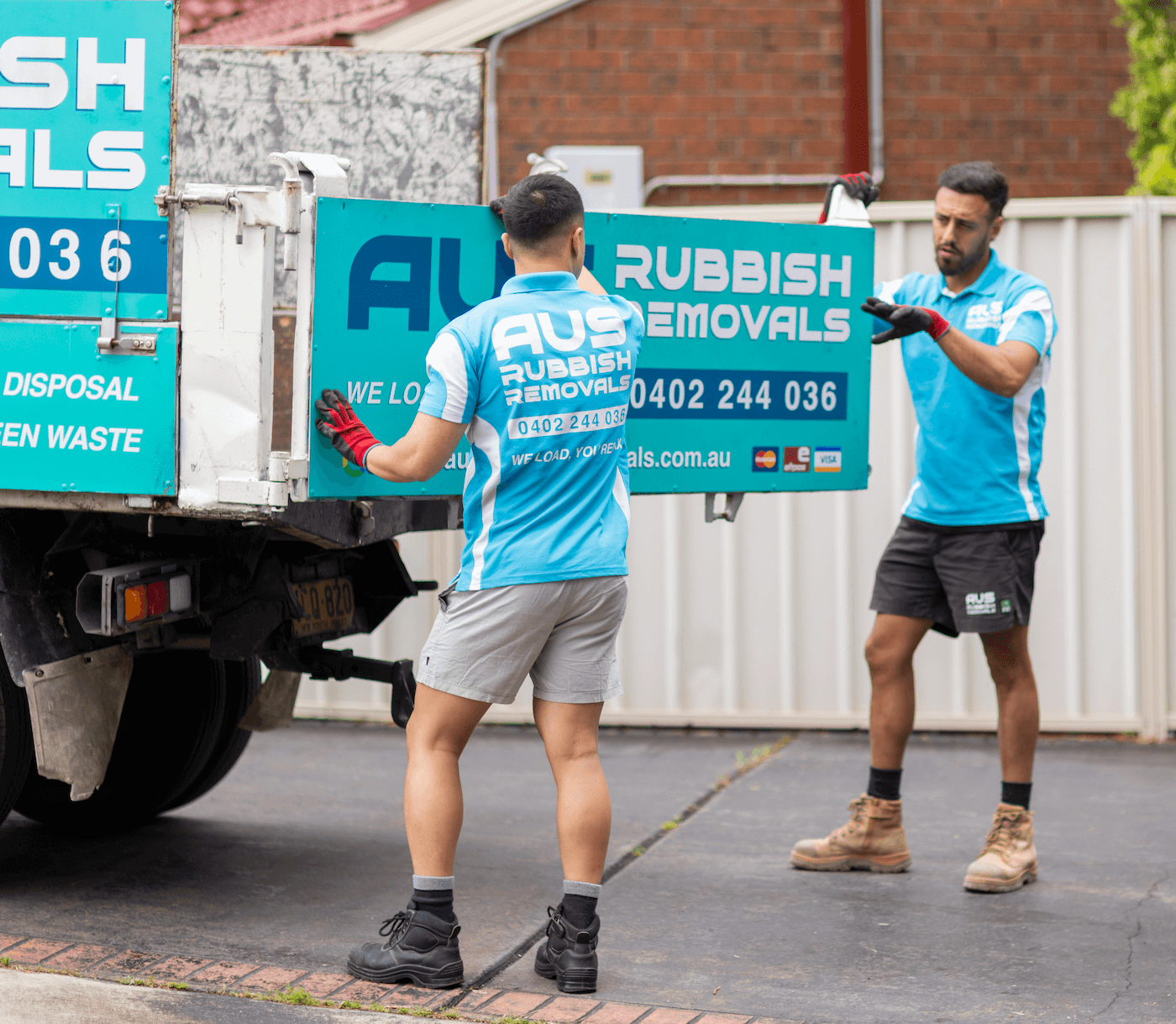
At Rubbish Removals, we can handle mountains of organic and general waste with our heavy-duty trucks, hauling equipment, and manpower. We provide same-day bulk food waste clearance so you can remove waste from your freezer, pantry, and storage to make room for a new supply.
If you’re dealing with an emergency fridge clear-out, an end-of-lease cleanup, or general household hoarding, our team can safely and quickly remove spoiled food and general household rubbish from the property.
At Aus Rubbish Removals in Sydney, we are an eco-friendly company, ensuring all waste is disposed of in accordance with NSW EPA guidelines [11]. We take food waste to organic recycling facilities where possible.
Frequently Asked Questions
How much food does the average Australian household waste?
An average Australian household throws away around 1 in 5 grocery bags, costing up to $2500 in wasted food each year [12].
Why can’t food waste just go in the normal rubbish bin?
Food can’t go into regular trash bins because it eventually ends up in standard landfills, where it produces highly toxic methane gas. Food waste must be separated for commercial composting or FOGO to reduce methane emissions.
Can Aus Rubbish Removals clear out a broken commercial freezer?
Yes, we provide same-day emergency clearance of bulk spoiled food and general waste from a broken commercial freezer.
Do you provide regular household rubbish removal?
Yes, we take regular household rubbish aside from bulk organic clear-outs. We clear out household rubbish, refrigerators and freezers, washing machines and dryers, and all types of household furniture.
Call Us For Same-Day Bulk Food Waste Removal
Australia may still have a long way to go before it meets its 2030 food waste reduction targets, but it’s still possible through better consumer habits and responsible waste disposal.
Stuck with a massive pile of spoiled food from a broken fridge or post-event commercial waste? Let us handle the messy work. Call Aus Rubbish Removals today for fast, eco-friendly bulk food and general household rubbish clearance across Sydney.
References
[1] Australian Government Department of Climate Change, Energy, the Environment and Water – Reducing Australia’s food waste
[2] Australian Government Department of Climate Change, Energy, the Environment and Water – National Food Waste Strategy
[3] Nutritics – How Food Business Can Help Tackle Australia’s Food Waste Issue
[4] Waste Management Review – Research reveals household food waste cost
[5] End Food Waste Australia – Gander Retail Waste Saving Program
[6] Clean Up Australia – The Issue with Food Waste
[7] UNECE – About Methane Management
[8] Waste Sorted – What is FOGO?
[9] Compost Connect – What Governments in Australia Are Doing to Support Composting
[10] OzHarvest – Who We Are
[11] NSW EPA – Businesses must separate food waste
[12] Foodwise – Household food waste